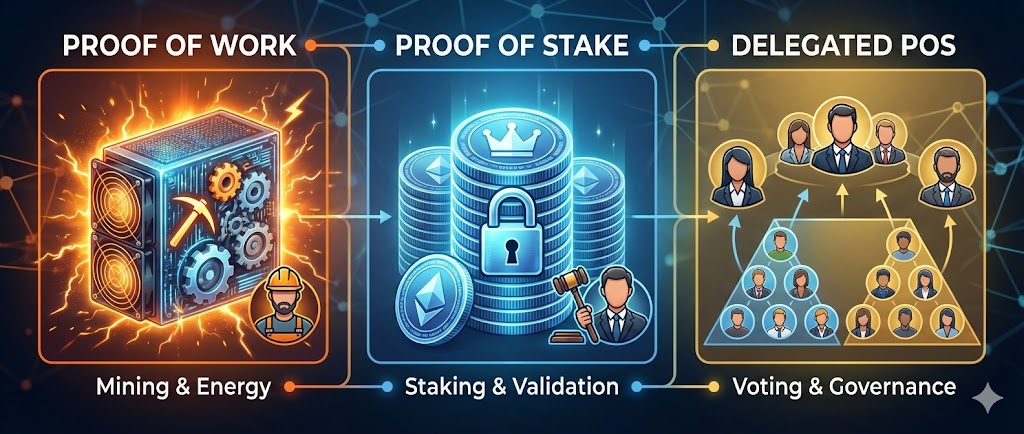
What’s the Difference Between PoW, PoS, and Delegated PoS? (2026 update)
A 2026 comparison of proof of work, proof of stake, delegated proof of stake, and newer consensus families without the marketing fog.
A blockchain is a network of computers that needs to agree on one shared history: who sent what to whom, and in which order.
The method used to reach that agreement is called a consensus mechanism.
This post refreshes the classic trio (PoW / PoS / dPoS), fixes a few outdated assumptions, and adds a quick map of consensus families you’ll still run into in 2026.
If you’re brand new, read the basics of cryptocurrency first.
Proof of Work (PoW)
PoW is the original Bitcoin-style consensus. Miners compete to find a valid block by performing computational work (hashing). The first miner to find a valid block:
- publishes the block
- earns a block reward + transaction fees
- everyone else verifies and builds on top
Bitcoin’s average block interval is ~10 minutes (from the Bitcoin whitepaper).
Reward reality check (2026)
After the April 2024 halving, Bitcoin’s block subsidy became 3.125 BTC per block (e.g. Kraken’s halving explainer or Investopedia).
PoW advantages
- Battle-tested simplicity: easy to reason about, easy to verify.
- External cost: rewriting history is expensive because you need energy + hardware.
- Permissionless participation: anyone can try to mine (in theory, but not so in practice).
PoW downsides (the ones that matter)
- Energy cost: PoW has a measurable electricity footprint. The Cambridge Bitcoin Electricity Consumption Index (CBECI) tracks estimates and methodology (CBECI). The U.S. EIA summarizes CBECI ranges, for example estimating 2023 Bitcoin mining at roughly 67–240 TWh with a point estimate around 120 TWh (EIA summary).
- Mining centralization pressure: mining tends to concentrate where energy is cheapest and where regulation is favorable. Cambridge also maintains a mining map based on pool geolocation data (Cambridge mining map).
- Throughput limits: only so many transactions fit per block; congestion can raise fees.
Proof of Stake (PoS)
PoS replaces “work” with “stake”. Validators lock up funds and participate in block production and validation. If they cheat, they can be penalized (slashed). If they behave, they earn rewards.
Ethereum is the flagship example: it transitioned to PoS in 2022 with The Merge (ethereum.org: The Merge).
How PoS works (high level)
- validators are selected according to protocol rules (stake-weighted randomness, committees, etc.)
- they propose and attest to blocks
- finality is achieved via the consensus rules (Ethereum’s PoS is documented on ethereum.org: Proof-of-stake)
To run an Ethereum validator, you deposit 32 ETH (ethereum.org staking).
PoS advantages
- Massive energy reduction compared to PoW for similar security goals (Ethereum’s own docs explain the post-Merge energy impact: ethereum.org energy consumption).
- Faster finality models (depending on design).
- Lower hardware barrier (you don’t need ASIC farms).
PoS downsides and tradeoffs
- Stake concentration: if stake concentrates, governance and validation power concentrates.
- New failure modes: slashing, client bugs, correlated failures, and “social consensus” becomes more visible.
- Nothing-at-stake is not “solved by vibes”: modern PoS designs address it with slashing/finality rules, but it’s an additional layer of complexity.
Delegated Proof of Stake (dPoS)
dPoS is PoS with a political layer:
- token holders vote for a small set of delegates / block producers
- those delegates produce blocks and earn rewards
- the community can vote them out
This is often marketed as “more scalable” because fewer validators can coordinate quickly — but fewer validators also means more centralization risk.
dPoS advantages
- fast block times and high throughput (coordination is easier)
- clear governance mechanics (“vote out bad actors”)
- lower infrastructure complexity for everyday users
dPoS downsides
- cartelization is realistic: delegates can collude, buy votes, or form entrenched blocs
- governance becomes politics (lobbying, bribery, “delegate campaigns”)
Other consensus families you’ll see in 2026 (quick map)
This is the part older explainers often miss: the ecosystem moved on. “PoW vs PoS” is not the whole world.
Proof of Authority (PoA)
A permissioned set of validators produce blocks. Security is based on identity/reputation rather than stake or work. Useful for:
- private/consortium chains
- some testnets
- enterprise networks
Ethereum docs describe PoA as a common testnet approach historically (ethereum.org Networks docs).
BFT-style PoS (Tendermint / CometBFT)
Many chains use a Byzantine Fault Tolerant consensus that can tolerate up to ~1/3 faulty voting power, with fast finality.
Tendermint describes itself as a consensus engine ensuring the same transactions are recorded in the same order across machines (Tendermint docs). Cosmos explainer material notes the “up to 1/3 faulty nodes” tolerance (Cosmos Academy overview).
Avalanche family (random subsampled voting)
Avalanche’s Snow family reaches consensus through repeated random sampling, aiming for sub-second finality under the right network conditions (Avalanche Snowman docs).
“Proof of History” (timekeeping) + PoS (Solana-style)
Solana’s Proof of History is a cryptographic time-ordering mechanism used alongside PoS, described by the Solana Foundation as a way to bring a verifiable ordering of events (Solana Foundation: Proof of History).
(Important nuance: PoH is not “consensus by itself”; it’s a component that helps a PoS consensus run faster.)
Research-backed PoS (Ouroboros / Cardano)
Cardano’s docs describe Ouroboros as its PoS consensus protocol and highlight peer-reviewed research roots (Ouroboros overview).
Conclusion
PoW, PoS, and dPoS are three big buckets, but they’re not the whole story in 2026.
- PoW: simple, expensive, and energy-hungry; secure but resource-intensive.
- PoS: efficient, more complex; shifts the security model to stake + slashing.
- dPoS: fast and political; centralization risks are the price of performance.
- BFT and random-sampling families: very common now; often optimized for fast finality.
If you’re holding coins, you mostly care about security and decentralization. If you’re building apps, you also care about:
- finality guarantees
- censorship resistance
- liveness under stress
- operational complexity
Those properties matter more than the marketing label.